
Getting Brand Community Marketing Right: Tools and Strategies for Modern Cult Brands
The Case for Brand Community Marketing in 2026
Brand community marketing is one of the highest-ROI strategies available to modern businesses — and most brands are still doing it wrong.
Here’s what it means and why it works:
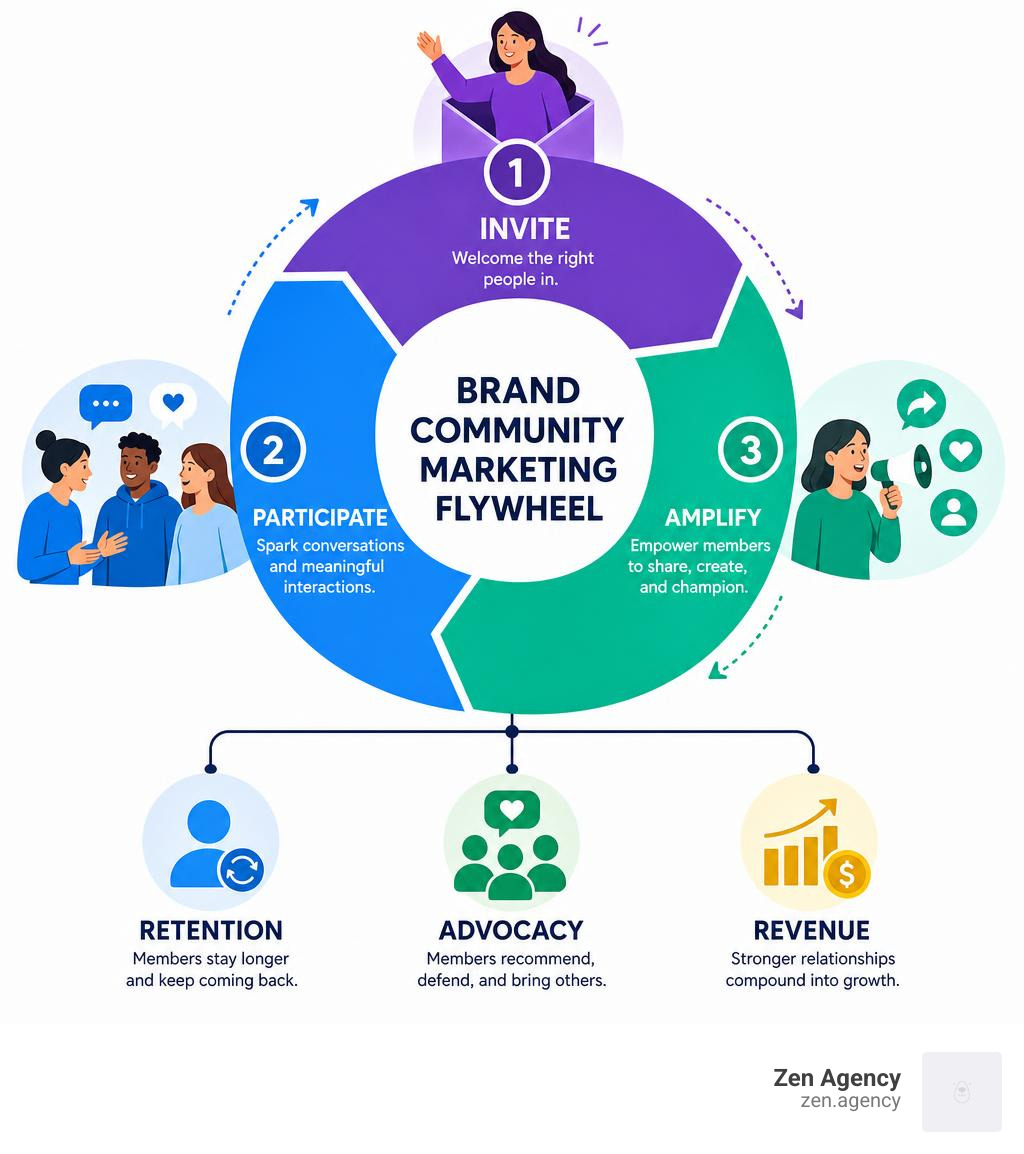
What is brand community marketing? Brand community marketing is the practice of bringing customers together around a shared identity, problem, or passion — and turning that group into a self-sustaining engine of advocacy, retention, and revenue. Unlike a social following, a true community is active: members talk to each other, not just to the brand.
Why does it matter right now?
- Paid media costs are rising while returns shrink
- Algorithms limit organic reach on every major platform
- AI-generated content is flooding the internet, making human connection a competitive advantage
- 67% of consumers say they feel more connected to brands through community than through social media
- Community marketing tactics generate an average 6,469% ROI
What does it actually do for your business?
| Outcome | How Community Drives It |
|---|---|
| Lower acquisition costs | Members refer new customers organically |
| Higher retention | Belonging creates emotional switching costs |
| More revenue per customer | Repeat purchases compound over time |
| Cheaper content | User-generated content replaces paid production |
| Better products | Community feedback informs development |
Consider what happened to Harley-Davidson. In 1983, the company was near extinction. Instead of doubling down on advertising, they built a lifestyle community around the identity of their riders. Twenty-five years later, the brand was valued at $7.8 billion. That is not a marketing campaign result. That is what a community does over time.
The pattern holds across industries — from Glossier’s beauty advocates to Figma’s global designer chapters to Sephora’s Beauty Insider program, which drives 80% of the company’s overall sales. The brands winning right now are not the ones with the biggest ad budgets. They are the ones with the strongest communities.
I’m Joseph Riviello, CEO and founder of Zen Agency, and with over 22 years of experience helping businesses scale through digital strategy, I’ve seen brand community marketing move from a “nice to have” to one of the most commercially important investments a brand can make. This guide gives you the frameworks, real-world examples, and step-by-step strategies to build one that actually drives results.
What Brand Community Marketing Is—and Why It Matters in 2026
Brand community marketing is not “posting more on social.” It is the strategy of creating a space where customers, fans, partners, and advocates build relationships around your brand’s mission, category, identity, or shared problem.
The key word is relationships.
A brand community becomes valuable when members do more than consume content. They ask questions. They help each other. They share wins. They create content. They recommend products. They defend the brand when needed. They become part of the brand’s operating system.
That is why community is becoming so important in 2025–2026. Businesses are dealing with higher acquisition costs, weaker organic reach, privacy changes, AI-generated content overload, and customers who trust peers more than polished advertising. In that environment, community becomes a trust engine.
For a deeper strategic breakdown, this article on brand communities and why many brands get them wrong makes a useful point: strong communities are not built around products alone. They are built around identity, lifestyle, and shared meaning.
Brand Community vs Audience vs Social Following
A simple way to understand the difference:
An audience listens.
A following reacts.
A loyalty program rewards.
A community participates.
| Type | Main Relationship | Typical Behavior | Business Value | Limitation |
|---|---|---|---|---|
| Audience | Brand to person | Reads, watches, subscribes | Awareness | Mostly passive |
| Social following | Person to brand | Likes, comments, shares | Reach and visibility | Platform-controlled |
| Loyalty program | Customer to rewards | Earns points, redeems perks | Repeat purchases | Often transactional |
| Brand community | Member to member and brand | Contributes, helps, advocates, co-creates | Retention, referrals, insight, revenue | Requires real management |
A true community has member-to-member interaction. If every conversation depends on your brand starting it, you have an audience with a comment section. That is useful, but it is not yet a community.
Why Brand Community Marketing Is a Strategic Priority in 2025–2026
The economics are pushing brands toward community.
- 66% of companies say their community significantly impacts customer retention.
- 62% of brand communities name retention as a priority.
- 80% of startups are investing in community as a primary marketing strategy.
- 28% of startups consider community the factor most critical to success.
- 40.1% of consumers say they are more likely to stay loyal after engaging in an online brand community.
The academic research supports the same pattern. A study on online brand community engagement and the consumer-brand relationship found that online community engagement influences participation, willingness to co-create, positive word of mouth, and loyalty-related outcomes.
The business takeaway is simple: customers who feel connected are more likely to stay, buy again, refer, and contribute.
The Commercial Difference: Why Communities Outperform Campaigns
Campaigns end. Communities compound.
A campaign may produce a short-term spike in traffic or sales. A community can create ongoing loops of:
- Repeat purchase
- Referral
- User-generated content
- Product feedback
- Peer support
- Review generation
- Organic search visibility
- Brand preference
This is where the community flywheel matters. A useful explanation of this model is available in HeyOrca’s guide to the community flywheel, which frames community growth around inviting people in, encouraging participation, and amplifying member activity.
When this works, your customers do part of the marketing with you. Not because you bribed them with a coupon, but because participation gives them status, belonging, usefulness, or identity.
The Four Pillars of a Thriving Brand Community

Strong communities usually rest on four pillars:
- Content
- Conversation
- Connection
- Co-creation
If one pillar is missing, the community wobbles. If all four are working together, it starts to feel less like a marketing channel and more like a living ecosystem.
Pillar 1: Content That Starts Participation
Community content should not only inform. It should invite.
Good community content includes:
- Behind-the-scenes stories
- Tutorials
- Member spotlights
- Templates
- Challenges
- Polls
- “Show us how you use it” prompts
- Customer success stories
- Product education
- Founder notes
- User-generated content
The best content creates a reason for members to respond. For example, instead of posting “Here is our new product,” ask, “Which version would you use first, and why?” That small shift turns content into participation.
This also needs to fit your broader brand strategy. If your community voice, values, and visual system feel inconsistent, people will not know what they are joining. Our guide on how to build a brand that lasts explains why durable brands need more than logos and campaigns; they need a clear promise people can believe in.
For brands still formalizing their identity, resources like our guides to brand guideline creation and the brand identity design process can help create the foundation a community can rally around.
Pillar 2: Conversation That Builds Trust
Conversation is where trust is earned.
This includes:
- Fast responses to questions
- Thoughtful replies to comments
- Community manager presence
- AMAs and office hours
- Direct messages
- Peer answers
- Transparent updates
- Feedback loops
- Conflict moderation
The goal is not to control every conversation. The goal is to create a safe, useful space where people feel heard.
A simple rule: if members only hear from you when you are selling something, they will learn to ignore you. Community trust is built in the boring middle: answering questions, acknowledging feedback, celebrating members, fixing problems, and showing up consistently.
Yes, even when nobody claps. Especially then.
Pillar 3: Connection Between Members, Not Just the Brand
A community becomes powerful when members care about each other.
Ways to create member-to-member connection include:
- Welcome threads
- Member introductions
- Local meetups
- Hybrid events
- Shared challenges
- Progress tracking
- Peer support channels
- Ambassador programs
- Community rituals
- Member badges or status levels
- Small group discussions
This applies whether you are a local business in Pennsylvania, a service brand in Montana, an ecommerce company, or a B2B software provider. The shared context may change, but the human need is the same: people want to feel like they belong somewhere useful.
Pillar 4: Co-Creation That Turns Customers Into Builders
Co-creation is where community becomes a competitive advantage.
Members can help shape:
- Product features
- Content topics
- Event themes
- Service improvements
- Packaging
- Customer education
- Beta programs
- Roadmap priorities
- New offers
Figma is one of the clearest modern examples. Its community has helped shape product direction through observed user behavior, feedback, shared files, events, and global chapters. This interview on Figma’s community marketing strategy shows how community can become deeply connected to product development, not just social engagement.
The lesson: do not just ask customers to buy. Ask them to build with you.
How Modern Cult Brands Drive Retention, Advocacy, and Revenue

Cult brands are not “cult” because they have clever slogans. They are cult brands because customers use the brand to say something about themselves.
Harley-Davidson: Community as Business Turnaround
Harley-Davidson’s turnaround is one of the classic brand community stories. Facing severe pressure in the early 1980s, the company leaned into rider identity, owner groups, rallies, and motorcycle culture.
The product mattered, of course. But the community made the product mean more.
Riders were not just buying transportation. They were joining a lifestyle. That emotional connection created advocacy, loyalty, and a moat that competitors could not easily copy.
Glossier, Sephora, and GoPro: UGC, Reviews, and Beauty-Led Advocacy
Glossier grew in part by treating customers as collaborators and amplifiers. Customer selfies, reviews, beauty conversations, and feedback loops helped make buyers feel like insiders.
Sephora’s Beauty Insider program shows how loyalty and community can overlap. Its community and rewards ecosystem has been reported to drive 80% of overall sales. That is what happens when customers return not only for products, but for recognition, education, and belonging.
GoPro is another strong example. Its customers create the kind of content most brands would pay agencies to produce: adventure footage, product demos, tutorials, and aspirational storytelling. UGC is especially powerful because it feels real. Research cited in the industry often finds user-generated content to be far more influential than brand-created messaging.
Nike and Figma: Community Built Around Identity and Use Cases
Nike Run Club is not just about shoes. It is about becoming a runner, tracking progress, joining challenges, and feeling part of a movement.
Figma is not just about design software. It is about collaboration, shared files, community events, templates, and practitioners helping practitioners.
That is the pattern: the strongest communities are built around what customers are trying to become or accomplish.
How Brand Community Marketing Reduces CAC and Increases LTV
Brand community marketing reduces customer acquisition cost because members create earned distribution:
- Referrals
- Reviews
- Social proof
- UGC
- Peer recommendations
- Branded search
- Word of mouth
- Community-led launches
It increases lifetime value because members are more likely to:
- Buy repeatedly
- Adopt more products
- Stay through small mistakes
- Upgrade or expand
- Invite others
- Give feedback
- Participate in future launches
This is why community should not be measured only as an engagement tactic. It is a retention, acquisition, product, and revenue strategy.
HubSpot’s guide to community marketing, advocacy, and reducing CAC makes a similar point: community becomes more valuable when it connects to lifecycle data, CRM insights, and measurable customer behavior.
Launch and Scale Framework: From First Members to Community Flywheel
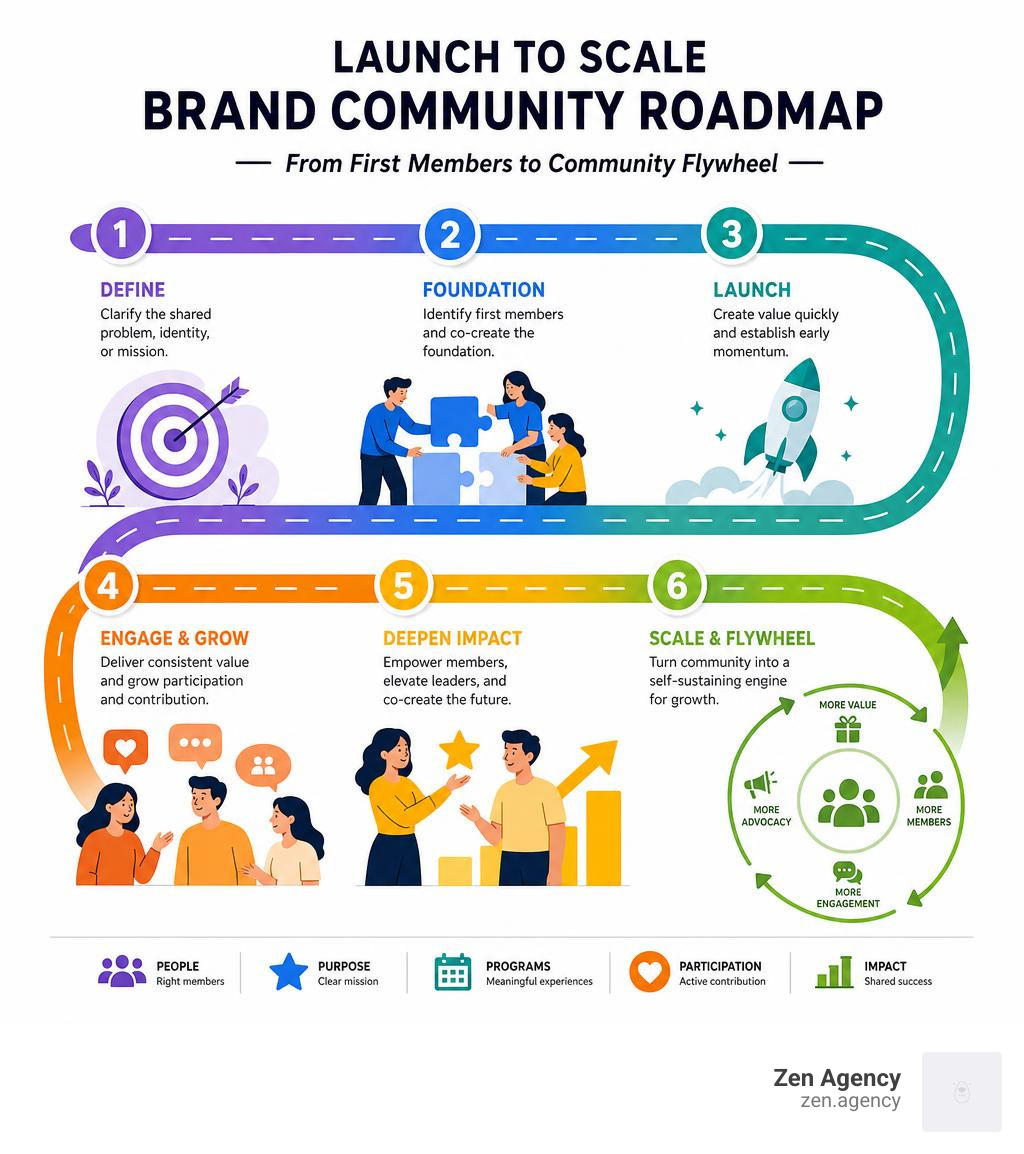
A strong community does not begin with “Let’s start a Discord.” That is platform-first thinking, and it creates many sad little ghost towns on the internet.
Start with purpose, people, and programming.
Step 1: Define the Shared Problem, Identity, or Mission
Before choosing tools, answer these questions:
- Who is this community for?
- What do they care about?
- What problem do they want solved?
- What identity do they want to claim?
- What can they do together that they cannot do alone?
- Why should they return every week?
Your community should be built around the customer’s world, not your product catalog.
Examples:
- Not “a community for our skincare brand,” but “a space for people building simple, confident skincare routines.”
- Not “a community for our SaaS tool,” but “a space for operations leaders solving workflow chaos.”
- Not “a community for our fitness store,” but “a space for everyday runners building consistency.”
For more on shaping that identity, see our guide to the brand identity design process.
Step 2: Recruit the First 50–200 Founding Members
Your first members set the tone. Choose carefully.
Look for:
- Loyal customers
- Power users
- Repeat buyers
- Advocates
- Creators
- Helpful commenters
- Event attendees
- Beta testers
- Partners
- Customers who already refer others
Start manually. Invite them personally. Interview them. Ask what they want from the community. Give them a founding role.
For smaller brands, 20 to 50 great founding members can be enough. For larger brands, 100 to 200 may be more realistic. Either way, culture forms early. Do not outsource it to randomness.
Step 3: Choose the Right Platform Mix
There is no universal best platform.
Your platform depends on:
- Where your audience already spends time
- How private the conversations should be
- How much data you need
- Whether CRM integration matters
- Your moderation capacity
- Content format
- Event needs
- Budget
- Team resources
Common options include:
- Owned community platforms
- Private forums
- Email communities
- LinkedIn groups for B2B
- Discord-style spaces
- Customer portals
- Social media groups
- Live and hybrid events
- Loyalty program communities
A hybrid model often works best: use social platforms for discovery, then move core engagement into an owned or semi-owned space where you have more control.
For a practical overview of tools, see this community-building tools guide.
Step 4: Design Recurring Programs Members Return For
Communities need rhythm.
Useful community programs include:
- Weekly question threads
- Monthly office hours
- Member spotlights
- Product feedback labs
- Expert sessions
- Local meetups
- Virtual roundtables
- Challenges
- Ambassador programs
- Customer education sessions
- Peer mentoring
- Launch preview groups
- Community awards
- Referral prompts
- UGC contests
- Onboarding journeys
The goal is to create “recurring pull.” Members should know what happens, when it happens, and why it is worth showing up.
Step 5: Scale With Ambassadors, Influencers, and AI—Without Losing Trust
As the community grows, you need leverage.
Ambassadors can help welcome members, answer questions, lead events, create content, and model the right behavior.
Influencers can help when they are aligned with the community’s values, not just hired to drop a promo code and vanish into the mist.
AI can help with:
- Sentiment analysis
- Moderation flags
- Content suggestions
- Member segmentation
- Onboarding automation
- FAQ routing
- Trend detection
But AI should not replace human presence. In an AI-saturated internet, people are joining communities because they want real interaction. Use AI as the assistant, not the host.
Measurement, ROI, and Common Mistakes to Avoid
If you only measure follower count, you will miss the point.
Community ROI is measured by behavior change: do members buy more, stay longer, refer more, contribute more, and cost less to support?
Brand Community Marketing Metrics That Actually Matter
Track metrics like:
- Active participation rate
- Repeat purchase rate
- Churn rate differential
- Referral rate
- UGC volume
- Member-generated revenue
- Support ticket reduction
- Event attendance
- Product feedback adoption
- Expansion revenue
- Pipeline influence
- Branded search growth
- Review volume
- Member sentiment
- NPS
- Contribution rate
A healthy active participation rate will vary by business model, but many community operators look for meaningful participation from a focused group rather than shallow activity from a large group.
How to Prove Community ROI Beyond Follower Count
Use cohort analysis.
Compare members vs non-members:
| Metric | What to Compare |
|---|---|
| Retention | Do members churn less? |
| Repeat purchase | Do members buy more often? |
| Average order value | Do members spend more? |
| Referrals | Do members bring in new customers? |
| Support costs | Do peer answers reduce tickets? |
| Expansion | Do members adopt more services or products? |
| UGC | Do members create usable content? |
| Product insight | Do community ideas improve offers? |
Connect community data to your CRM wherever possible. Tag members, track referral sources, measure lifecycle stages, and review attribution over longer windows. Community impact often compounds over 6 to 24 months, not six days. Annoying for impatient executives, yes. True anyway.
The Most Common Brand Community Mistakes
Avoid these traps:
- Building around the brand instead of the customer’s world
- Treating community as a short-term acquisition campaign
- Choosing a platform before defining the mission
- Broadcasting instead of inviting participation
- Selling too early and too often
- Chasing member count instead of member quality
- Ignoring moderation
- Failing to recognize contributors
- Letting toxic behavior slide
- Ignoring feedback after asking for it
- Creating weak rituals
- Having no onboarding path
- Using fake engagement
- Over-automating with AI
- Excluding voices through poor community design
- Giving up before trust has time to form
If your community feels like a webinar waiting room, it is time to rethink the strategy.
B2C vs B2B Brand Communities: What Changes
B2C communities often center on:
- Lifestyle
- Identity
- Emotion
- UGC
- Reviews
- Events
- Loyalty programs
- Product discovery
- Shared values
B2B communities often center on:
- Expertise
- Peer learning
- Templates
- Best practices
- Partner ecosystems
- Certifications
- Product adoption
- Customer success
- Professional status
- Longer-term trust
In B2B, community can be especially powerful because buyers trust peers, sales cycles are longer, switching costs are higher, and LTV is often larger. A practitioner forum or customer advisory community may not look flashy, but it can quietly influence retention, expansion, and pipeline.
For companies comparing growth partners, our resources on brand promotion companies and top branding agency websites can help clarify what to look for in a brand-building partner.
Frequently Asked Questions About Brand Community Marketing
How Long Does It Take to Build a Brand Community That Drives Results?
You may see early engagement within a few months. Business outcomes usually take longer.
A practical timeline:
- 0–3 months: research, founding members, positioning, early rituals
- 3–6 months: engagement patterns, feedback loops, first advocates
- 6–12 months: measurable referrals, retention signals, UGC growth
- 12–24 months: stronger ROI visibility, community-led launches, compounding value
Some communities move faster, especially if the brand already has passionate customers. But in most cases, patience is part of the strategy.
Which Platform Is Best for a Brand Community?
The best platform is the one your members will actually use.
Ask:
- Do they prefer public or private conversations?
- Are they already active on LinkedIn, forums, email, or social groups?
- Do you need owned data?
- Do you need CRM integration?
- Will the community include events, content, support, or all three?
- Can your team moderate it properly?
For many brands, the best answer is hybrid: social for discovery, owned space for depth, email for retention, and events for connection.
Can Small Brands Build Strong Communities?
Yes. In fact, small brands often have an advantage.
They can be more personal, more focused, and less buried under legal and approval layers. A founder can reply directly. A small team can know members by name. A local business in Wilkes-Barre, Scranton, Kingston, Hazleton, Billings, or elsewhere in Pennsylvania and Montana can create in-person moments that larger brands struggle to replicate.
Small communities can be incredibly valuable if they are specific, active, and trusted.
Conclusion
Brand community marketing is not about collecting followers. It is about creating belonging that turns customers into advocates, collaborators, and long-term revenue drivers.
The brands that win in 2026 will not only ask, “How do we reach more people?” They will ask:
- How do we create trust?
- How do we help customers connect?
- How do we invite participation?
- How do we turn feedback into better products?
- How do we make our best customers feel seen?
- How do we build a flywheel that compounds?
At Zen Agency, we help businesses build the strategy, branding, websites, and digital marketing systems needed to support that kind of growth. Since 2008, we have focused on enterprise-grade solutions for businesses that are ready to increase visibility, profitability, and ROI.
If you are ready to turn your audience into a real growth asset, explore our digital marketing services and let’s build a community strategy that lasts.