Smarter B2B Lead Generation Without the Pipeline Burnout
Build a B2B Lead Generation Process That Produces Qualified Pipeline
Start with the right buyers, not more leads. Define your ideal customer profile and agree with sales on what makes a lead qualified. Then choose channels your buyers use, verify your contact data, and follow up with useful messages. Track which leads become meetings, opportunities, and revenue. Use those results to improve the process.
That discipline matters when B2B deals take months and several people have a say. A full contact list may look promising, but it will not help much if the people on it cannot or will not buy.
I’m Joseph Riviello, founder and CEO of Zen Agency, with more than 22 years of digital marketing leadership. My work on the b2b lead generation process focuses on connecting traffic and leads to conversions and revenue.
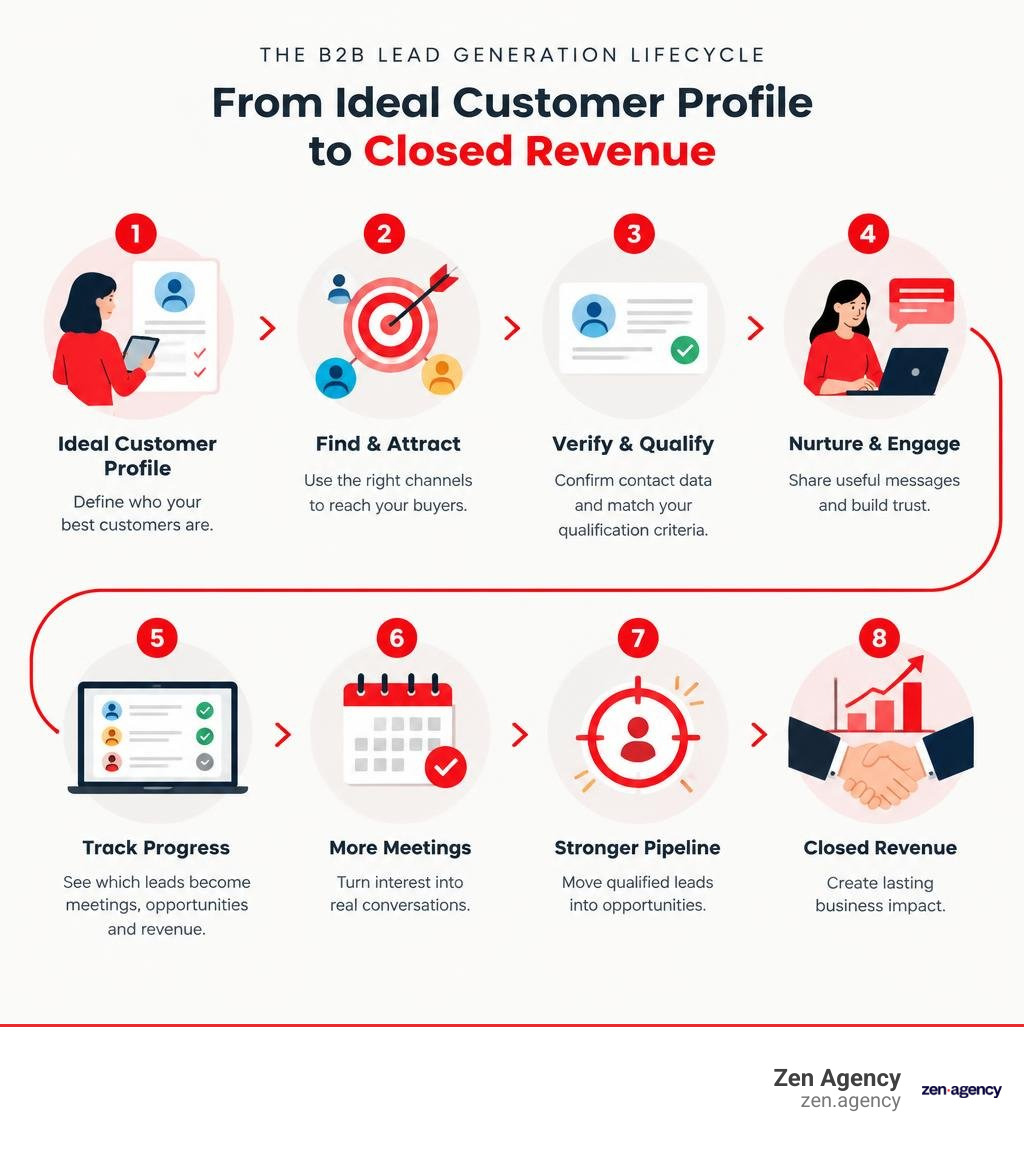
B2b lead generation process definitions:
- b2b lead generation and appointment setting
- b2b saas lead generation strategies
- lead generation services
The modern B2B buying environment is longer and more complex than ever. In 2026, the average B2B sales cycle stretches to 211 days for enterprise organizations and roughly 84 days for mid-market deals. Pipeline fatigue is real: sales reps burn out chasing disengaged contacts, while marketing teams celebrate vanity download spikes that never translate into closed deals.
At the same time, enterprise buying behaviors have shifted dramatically. A staggering 91% of B2B buyers prefer online purchasing and self-directed digital evaluation, and 94% of procurement executives now use AI tools in their sourcing and vendor assessment workflows. The global B2B e-commerce market—valued at $18,665.5 billion in 2023—is expanding at an annual rate of 18.2% through 2030. To capture high-value contracts in this climate, organizations must abandon disjointed outbound blasts and build an engineered, repeatable revenue engine.
B2B vs. B2C Lead Generation: Structural Dynamics and Demand Strategy
Understanding how commercial models dictate customer behavior is foundational to designing your acquisition funnels. In the United States, as many as 72% of firms with 500 or more employees primarily serve other businesses. Treating enterprise procurement like consumer retail is the fastest way to drain your marketing budget.
| Dimension | B2B Lead Generation | B2C Lead Generation |
|---|---|---|
| Sales Cycle Duration | Extended (84 to 211+ days) | Immediate to short (minutes to days) |
| Stakeholder Dynamics | Buying committees (6–10 decision-makers) | Single individual or household unit |
| Primary Decision Drivers | ROI, risk reduction, operational efficiency | Emotion, immediate gratification, price |
| Deal Size & Contract Value | High ($10k to $1M+ annual contract value) | Low to moderate transactional sums |
| Pricing Models | Custom negotiation, MSAs, and volume tiers | Standard fixed catalog pricing |
| Governance Structure | Formal contracts, security reviews, and SLAs | Simple terms of service and checkout |
In B2B commerce, transactions occur across both vertical models (specialized supply chains within single industries) and horizontal platforms (general-purpose operational services such as legal, banking, or cloud infrastructure). Because deals involve complex contractual and relational governance mechanisms, lead generation must cater to multiple perspectives within a single target account.
Exploring navigating B2B vs B2C lead generation strategies shows that while consumer marketing relies on impulsive triggers, B2B campaigns must validate measurable business value across economic buyers, technical evaluators, and end users alike.
Inbound vs. Outbound Lead Generation: Choosing the Right Mix
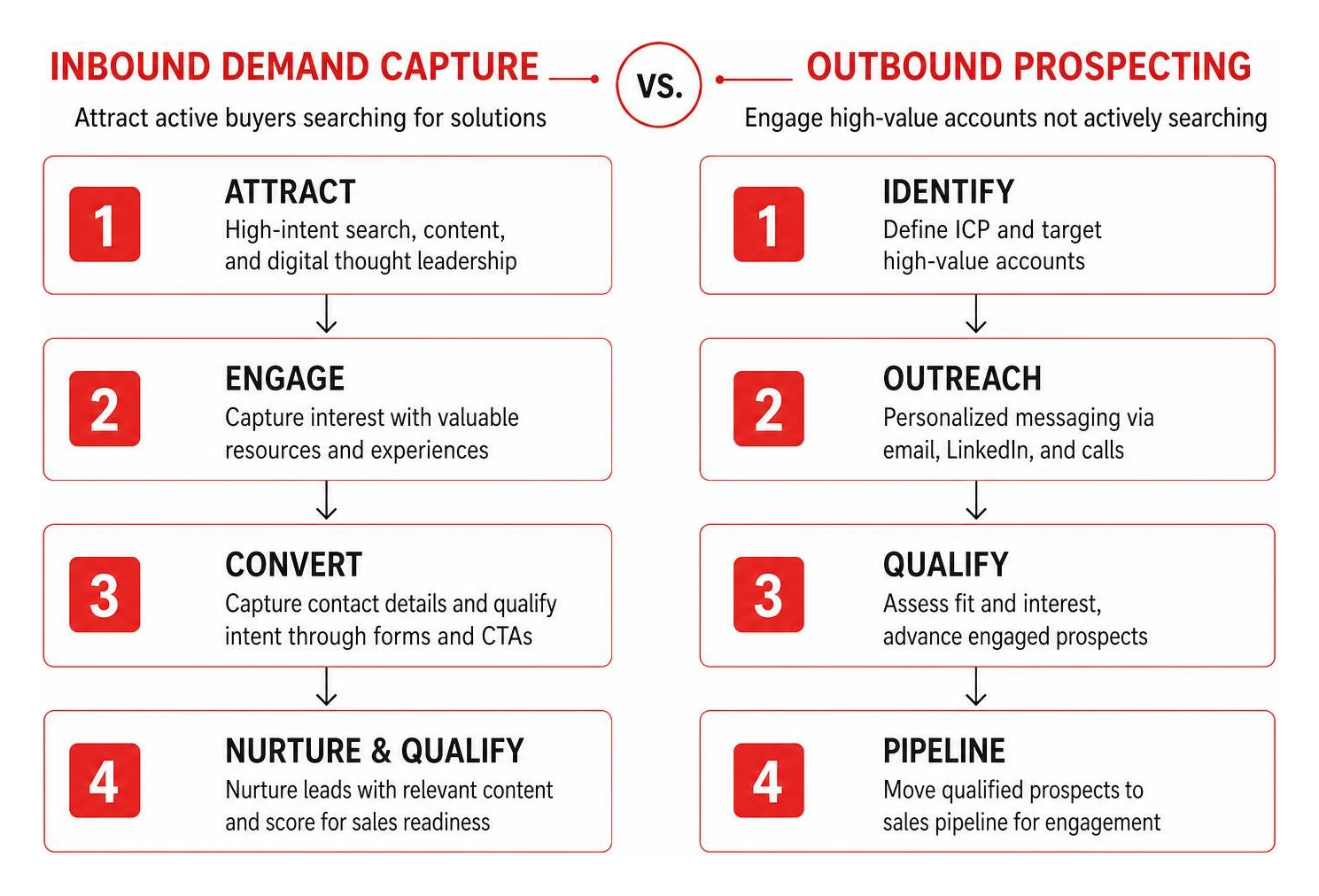
A balanced pipeline requires orchestrating both demand capture (inbound) and demand creation (outbound). Inbound lead generation leverages high-intent search traffic, digital thought leadership, and educational assets to draw active prospects into your ecosystem. When decision-makers actively search for solutions, building a lead generation funnel that converts captures those ready-to-buy signals at the exact moment of intent.
Conversely, outbound prospecting directly targets high-value accounts that match your exact profile but may not be actively searching today. Outbound is essential for high Average Contract Value (ACV) solutions where the total addressable market is narrow, while inbound scales efficiently across broad market segments.
Foundational Pillars: ICP Operationalization and Lead Qualification Frameworks
A lead generation engine is only as effective as the targeting criteria behind it. Successful teams operationalize their Ideal Customer Profile (ICP) using a two-layer qualification framework rather than a superficial checklist.
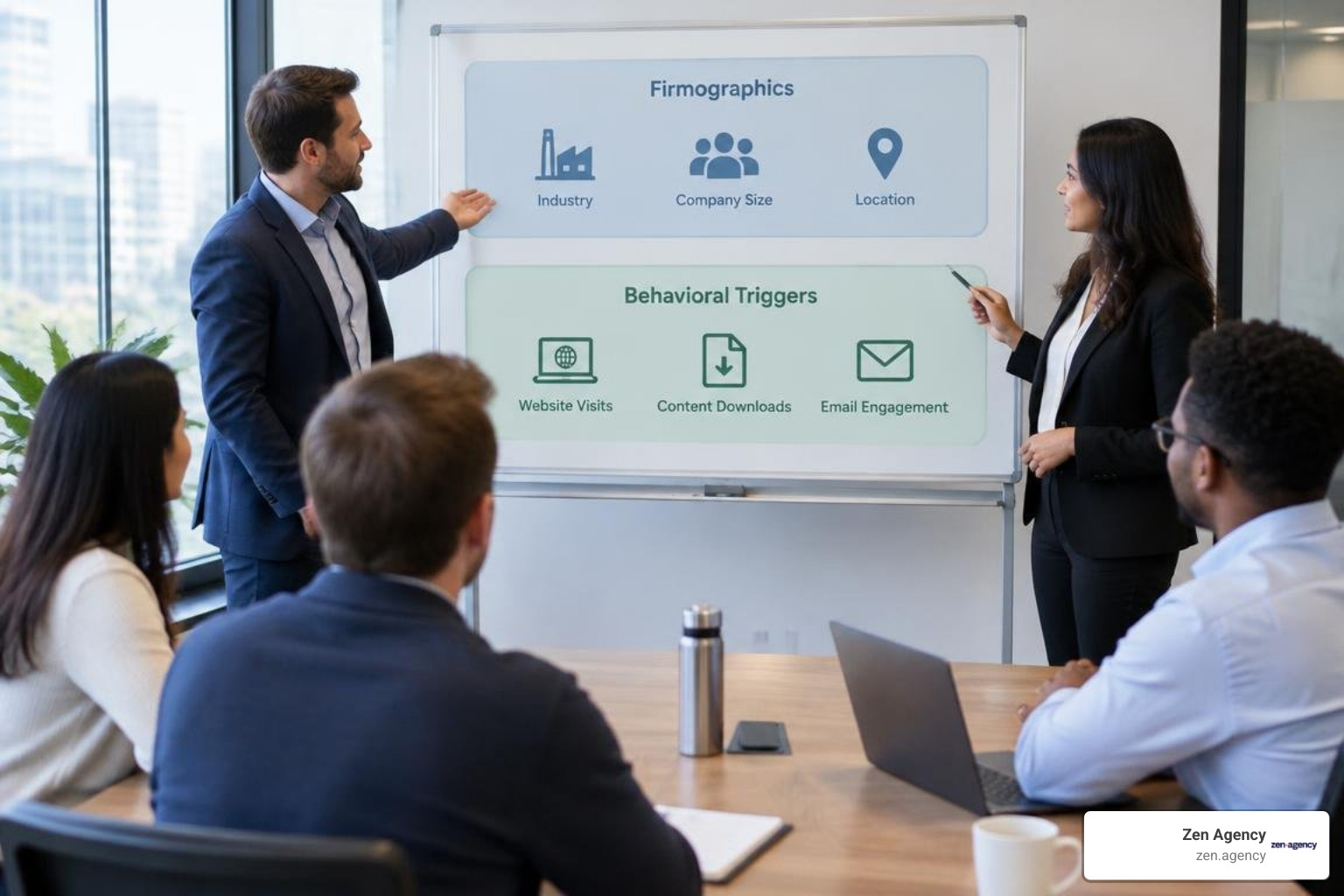
Layer 1: Structural Firmographics & Technographics
- Industry classifications and sub-verticals
- Company headcount (e.g., 50–500 employees for mid-market, 1,000+ for enterprise)
- Annual revenue bands and geographic boundaries
- Technographic footprint (e.g., CRM platforms, cloud architecture, CMS integrations)
Layer 2: Psychographic & Trigger-Based Signals
- Key leadership changes (e.g., a newly appointed VP of Sales or CIO)
- Recent capital raises or private equity acquisitions
- Expansion into new regional territories
- Active hiring sprees in specialized technical departments
Once accounts meet these profile criteria, sales teams evaluate active opportunities using structured frameworks:
- BANT (Budget, Authority, Need, Timeline): Ideal for transactional and mid-market sales motions where budget parameters and operational timelines are well established.
- MEDDIC (Metrics, Economic Buyer, Decision Criteria, Decision Process, Identify Pain, Champion): Essential for complex enterprise sales involving lengthy procurement governance and multi-stakeholder consensus.
To turn raw form fills into actionable pipeline, master how to qualify leads for better conversion rates. Layering behavioral intent on top of account fit is why lead scoring is essential for conversion strategy.
Aligning Sales and Marketing on MQL and SQL Definitions
Pipeline friction usually boils down to a lack of shared definitions between marketing and sales. Marketing celebrates thousands of top-of-funnel ebook downloads, while account executives complain that none of those contacts are ready for a sales conversation.
In high-performing B2B programs, the benchmark conversion rate from Marketing Qualified Lead (MQL) to Sales Qualified Lead (SQL) falls between 13% and 27%, with top-performing product-led teams reaching up to 35%.
To maintain alignment, establish unambiguous criteria:
- Marketing Qualified Lead (MQL): A prospect matching Tier-1 or Tier-2 ICP attributes who has demonstrated explicit high-intent behavior (e.g., requesting a demo, viewing pricing pages multiple times, or attending a high-value technical webinar).
- Sales Qualified Lead (SQL): An MQL vetted by a Sales Development Representative (SDR) that meets agreed-upon BANT/MEDDIC criteria and has committed to a discovery call.
Enforce formal Service Level Agreements (SLAs) between teams. Lead routing rules should require reps to engage high-intent inbound leads within 15 minutes. Testing a 15-minute response window against a 60-minute baseline repeatedly shows massive drops in qualification rates when follow-ups are delayed. Implementing proven tactics to improve lead quality ensures RevOps dashboards monitor SLA compliance transparently.
Auditing and Refining Your B2B Lead Generation Process Workflow
Even the most sophisticated messaging will fail if your contact database is corrupt. A list missing verified direct-dial numbers or work email addresses wastes SDR bandwidth and damages sender reputation.
Maintain regular operational hygiene:
- Clean and enrich contact data using automated validation tools before routing leads to sales cadences.
- Scrub syntax errors, remove outdated domains, and verify SMTP handshakes to keep hard bounce rates strictly under 2%.
- Enforce strict regulatory compliance with US standards, including CAN-SPAM (clear opt-out mechanisms, physical mailing addresses, honoring unsubscribes within 10 days) and TCPA regulations for phone outreach. Non-compliance risks penalties reaching up to $53,088 per violating message.
For deeper insights into data hygiene and sourcing protocols, consult a modern field guide to sourcing better data-driven leads.
Step-by-Step Architecture of an Effective B2B Lead Generation Process
Building an engine that reliably generates sales pipeline requires five sequential procedures executed over a disciplined 60-to-90-day implementation sprint.
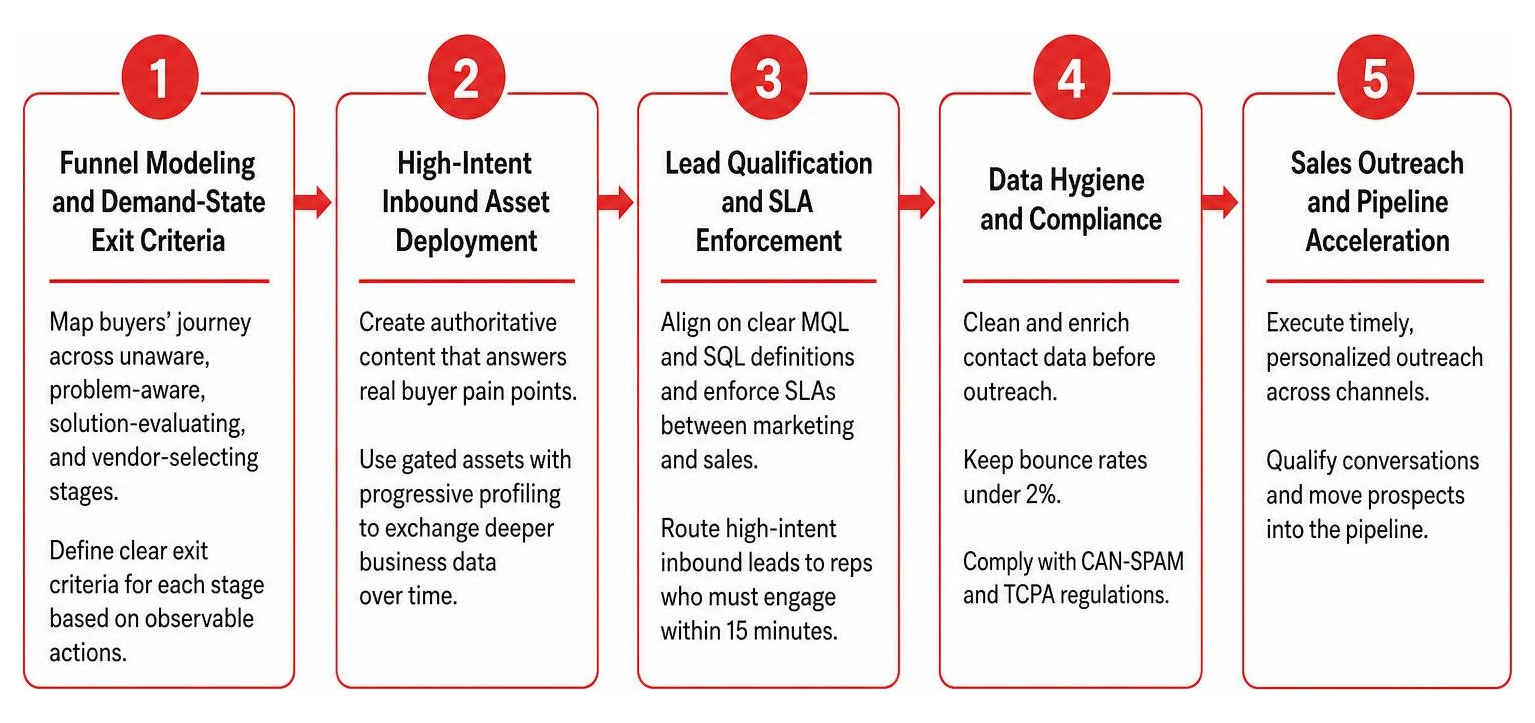
Step 1: Funnel Modeling and Demand-State Exit Criteria
Map out your buyers’ journey across distinct demand states: unaware, problem-aware, solution-evaluating, and vendor-selecting. Establish clear exit criteria for each stage based on observable actions rather than arbitrary timeframes.
Step 2: High-Intent Inbound Asset Deployment
Develop authoritative content that answers real buyer pain points. Pair gated research reports with progressive profiling forms so prospects can exchange deeper business data over time. Discover actionable paid search tactics in the B2B PPC playbook for winning at paid search, and align your editorial strategy by using content marketing for lead generation.
Step 3: Account-Based Outbound Targeting
Segment your target universe into distinct tiers. Tier-1 accounts (highest contract potential) receive bespoke research and multithreaded executive outreach, while Tier-2 accounts move through semi-automated, industry-specific sequences. For specialized SDR execution, integrate b2b lead generation and appointment setting workflows.
Step 4: Multi-Channel Cadence Execution
Launch coordinated touchpoints across email, phone, and social platforms over a structured timeline, ensuring messages deliver distinct value at every step.
Step 5: Attribution and Pipeline Review
Review pipeline velocity, acquisition costs, and channel-by-channel conversions on a weekly basis to reallocate budget toward top-performing segments.
Channel Strategy: Orchestrating LinkedIn, Search, and Account-Based Marketing
Selecting your promotional mix depends directly on deal size, search intent, and platform dynamics:
- LinkedIn Advertising: 95% of B2B marketers have sustained or increased their LinkedIn presence over the past year, with 85% citing it as their highest-value social network. LinkedIn Cost Per Lead (CPL) typically ranges from $80 to $200, making it the premier channel for precise account-based targeting, job-title filters, and native Lead Gen Forms.
- Google Search (PPC): Captures active buyers searching for direct solutions. Cost Per Click (CPC) for competitive B2B software and services terms runs between $15 and $80. Maximize conversion efficiency on paid traffic by understanding the role of high-intent landing pages in lead generation.
- Creative Differentiation: Professional audiences respond to well-crafted creative. Research shows 49% of B2B decision-makers are more likely to explore a brand if its advertising is creative, and 40% say engaging ad concepts increase their purchase consideration. B2B marketing must speak to real people, not just corporate titles.
- Workforce & Talent Alignment: Organizations scaling internal outreach can benchmark training against global workforce programs such as Generation, ensuring SDRs have the communication skills required for complex account engagement.
Designing Multichannel Cadences That Book Meetings
Relying on a single email blast is one of the most common reasons outreach campaigns underperform. A modern outbound campaign uses a 14-day multichannel cadence that balances persistence with professionalism.
Deliverability hygiene is critical throughout outreach. Keep your domain complaint rate strictly below 0.1% and follow proven best practices for how email marketing boosts lead generation efforts to safeguard domain health and inbox placement.
Pipeline Analytics, Revenue Attribution, and Avoiding Critical Pitfalls
Optimizing pipeline performance requires looking beyond top-of-funnel conversion metrics to evaluate real revenue impact across every acquisition channel.
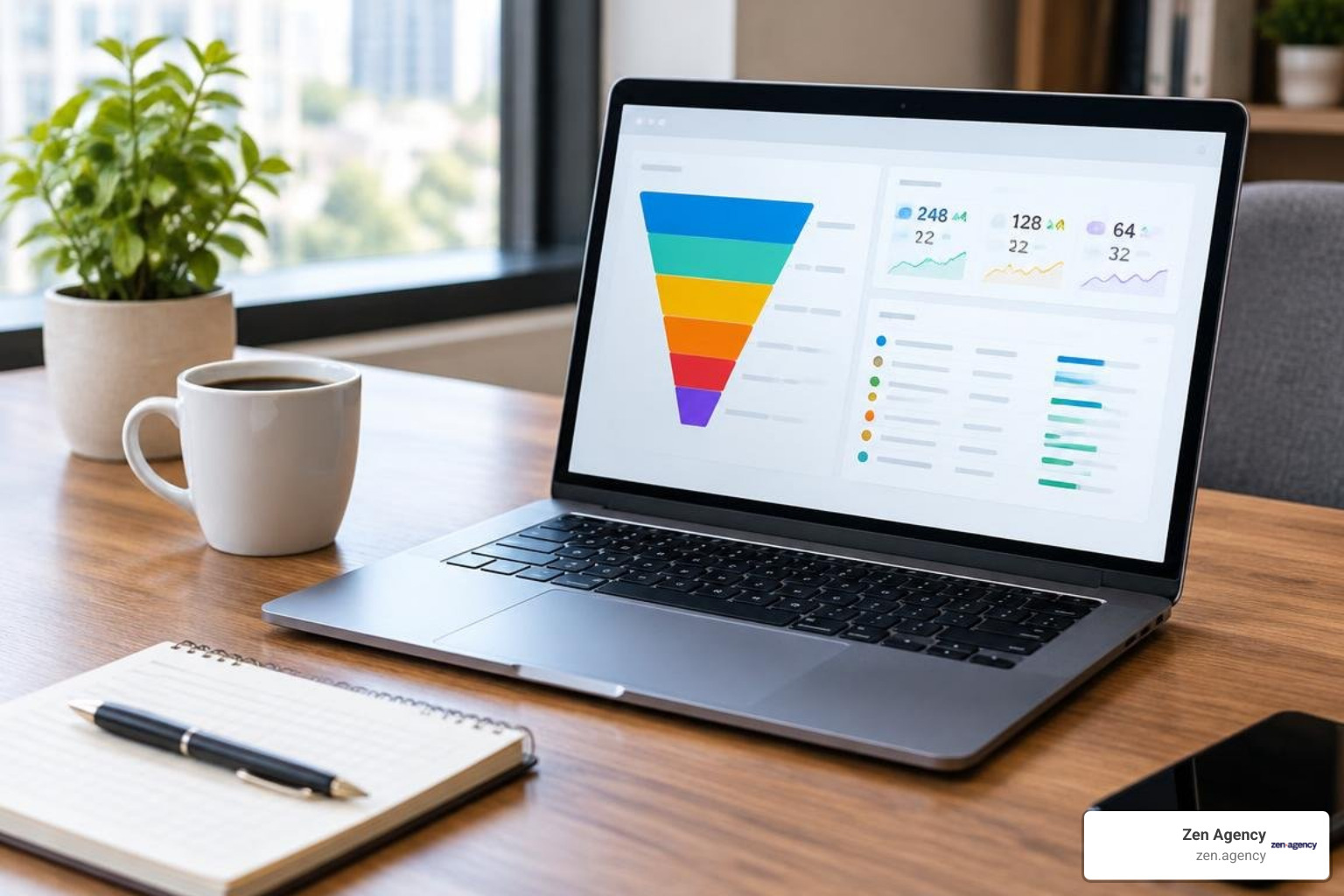
Track pipeline health using the Pipeline Velocity equation:
$$text{Pipeline Velocity} = frac{text{Number of Qualified Opportunities} times text{Average Deal Size} times text{Win Rate %}}{text{Sales Cycle Length (in Days)}}$$
Relying solely on last-touch attribution gives an incomplete picture of complex, multi-touch journeys. Adopt position-based or time-decay attribution models that properly credit early educational touchpoints alongside final demo requests, grounding your strategy in the 3 tenets of lead generation to produce sales on demand.
Key Metrics to Measure Your B2B Lead Generation Process Success
Keep leadership aligned on five core operational metrics:
- Customer Acquisition Cost (CAC) Payback Period: Target under 12 months for mid-market and under 18 months for enterprise accounts.
- Opportunity-to-Close Rate: Benchmark baseline of 20% to 30% for qualified mid-market deals.
- Cost Per Acquisition / Cost Per Lead (CPL): Tracked by individual channel to isolate acquisition efficiency.
- Marketing-Sourced vs. Marketing-Influenced Pipeline: Quantifying revenue directly attributed to demand generation versus sales outbound.
- Pipeline-to-Spend Ratio: Maintain a healthy pipeline creation ratio of at least 4x to 5x marketing investment, supported by lead generation automation to streamline your process.
Five Deadly Mistakes That Cause B2B Programs to Fail
Avoid these widespread strategic pitfalls:
- The Volume Trap: Flooding SDRs with low-quality contact lists rather than highly vetted, ICP-compliant target accounts.
- Premature Channel Shutdown: Abandoning programs (such as SEO or ABM) after 45 days before campaigns have time to compound and mature.
- Unverified Contact Blasting: Sending bulk emails to outdated lists, resulting in blacklisted domains and tanked inbox deliverability.
- Static Demographic Scoring: Relying solely on company size for lead scoring while ignoring real-time behavioral intent signals.
- Neglecting the Nurture Engine: Failing to support the 84-to-211-day sales cycle with educational nurture sequences. Discover how to keep mid-funnel deals warm by understanding the importance of lead nurturing in generating conversions.
Frequently Asked Questions About B2B Lead Generation
How long does it take to build a consistent B2B lead generation engine?
Building an enterprise-grade engine typically requires 60 to 90 days for initial infrastructure setup, ICP scoring rules, data enrichment, and outbound pilot sequences. Measurable pipeline velocity gains typically materialize between days 60 and 90, with compounding revenue growth scaling across months 6 through 12.
How do you calculate the exact number of monthly leads required to hit revenue goals?
Use reverse pipeline math:
- Identify your annual new revenue target (e.g., $2,000,000 new ARR).
- Divide by your Average Contract Value (e.g., $50,000 ACV = 40 closed deals needed per year, or ~3.33 per month).
- Factor in your Opportunity-to-Close Win Rate (at a 25% close rate, you need ~13.3 qualified SQL opportunities per month).
- Apply your MQL-to-SQL Conversion Rate (at a 20% conversion rate, you must generate ~67 verified MQLs monthly).
Should inbound or outbound lead generation come first for a new company?
In most scenarios, inbound foundation assets should be established first or built alongside outbound sprints. Outbound prospecting converts at significantly higher rates when target buyers can independently verify your brand authority, case studies, and digital footprint upon receiving an outreach message.
Building Predictable Revenue Systems
Scaling your B2B revenue engine does not mean burning out your sales team with endless cold outreach. True pipeline resilience comes from building an engineered lead generation process that systematically attracts high-intent buyers, qualifies them against strict ICP criteria, and nurtures them through complex buying journeys.
At Zen Agency, we help ambitious organizations build custom digital marketing engines, high-converting web architectures, and scalable acquisition systems that drive measurable ROI. Explore our custom B2B lead generation services to build a predictable, qualified pipeline for your business.