Find the Best Social Media Marketing Course Online to Boost Your Brand
Choose a Social Media Marketing Course That Builds Real Business Skills
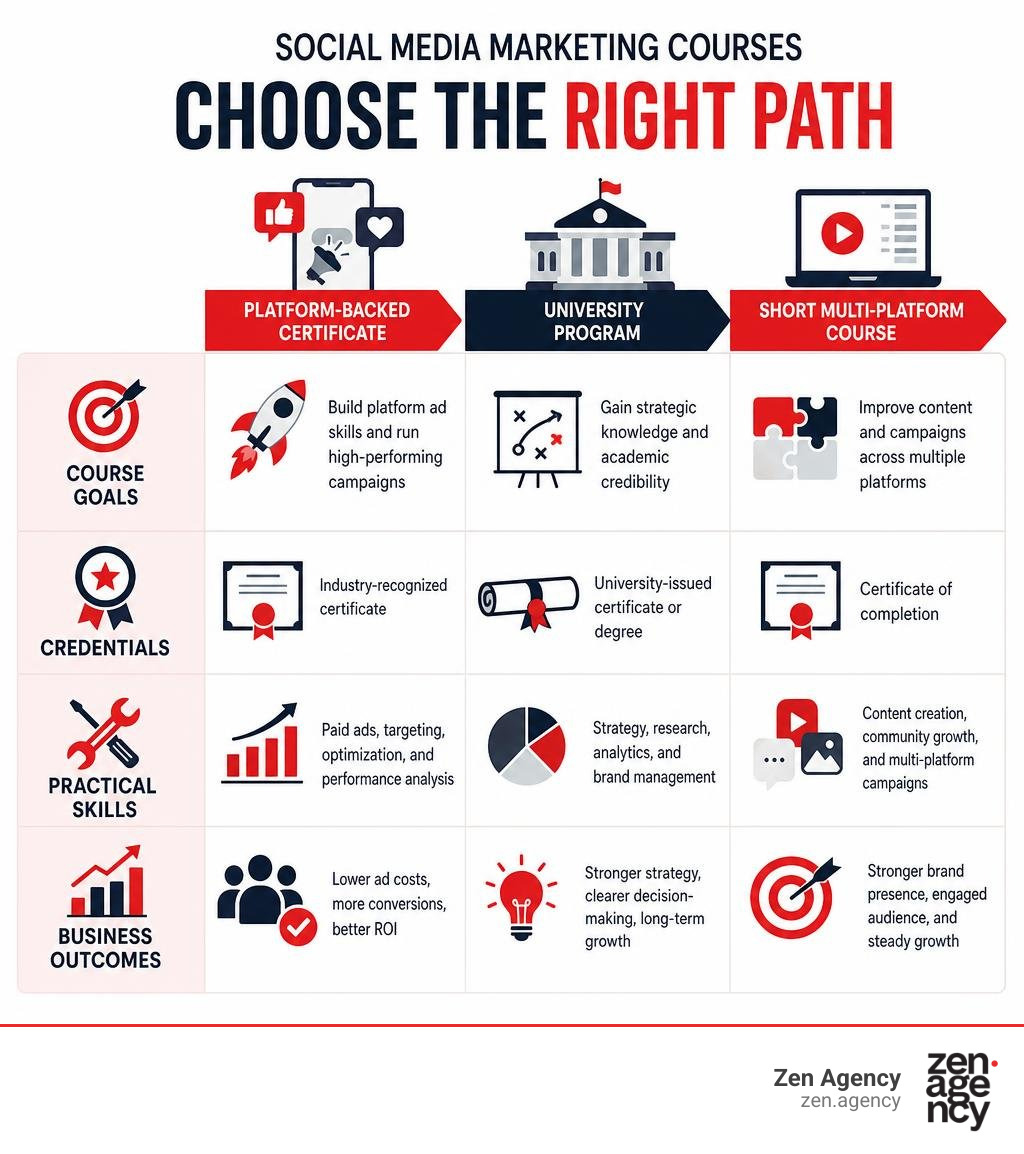
The best social media marketing course online depends on your goal. Choose a platform-backed certificate if you need hands-on ad skills, a university program if you need strategy and academic credibility, or a short multi-platform course if you need to improve your brand’s content and campaigns quickly.
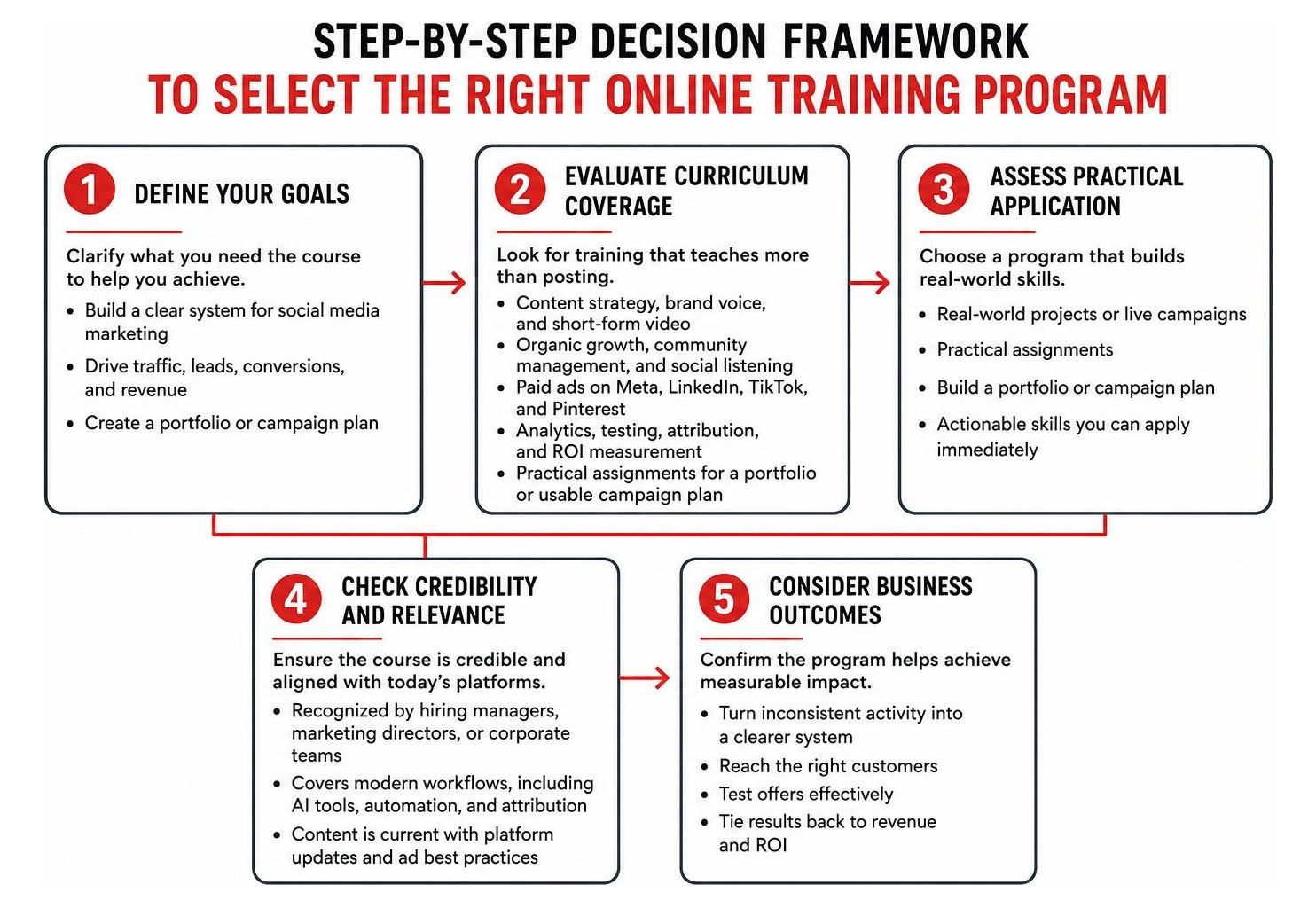
Look for training that teaches more than posting. A strong program should cover:
- Content strategy, brand voice, and short-form video
- Organic growth, community management, and social listening
- Paid ads on platforms such as Meta, LinkedIn, TikTok, and Pinterest
- Analytics, testing, attribution, and ROI measurement
- Practical assignments that create a portfolio or usable campaign plan
The right course can help a business owner turn inconsistent social activity into a clearer system for reaching customers, testing offers, and tying results back to revenue.
I’m Joseph Riviello, CEO and Founder of Zen Agency, with more than 22 years of experience helping companies grow through integrated digital marketing. I evaluate every social media marketing course online through the same lens: can it build the skills needed to drive traffic, leads, conversions, and profitable growth?
Relevant articles related to social media marketing course online:
Top Criteria to Choose a Social Media Marketing Course Online
Selecting an educational program requires balancing immediate practical needs with long-term strategic goals. Social platforms update their interfaces and algorithms frequently. A quality curriculum must teach both durable strategic frameworks and current tactical execution.
When we evaluate training programs at Zen Agency, we focus on measurable learning outcomes rather than vanity metrics or surface-level tips. Consider these criteria before enrolling:
- Curriculum Depth: Does the syllabus balance organic brand storytelling with paid media mechanics, analytics, and community management?
- Practical Application: Will you complete real-world projects, build live campaigns, or establish a working portfolio?
- Industry Credibility: Is the credential recognized by hiring managers, marketing directors, or corporate procurement teams?
- Technological Relevance: Does the instruction cover modern workflows, including generative AI tools, automated scheduling, and multi-network attribution?
Free vs Paid Social Media Marketing Course Online Options
Free online courses offer an accessible entry point for foundational concepts. For instance, the Social Media Marketing Certification Course from HubSpot Academy delivers a structured curriculum spanning 10 lessons, 38 videos, and 29 quizzes in roughly 5 hours and 18 minutes. It has helped over 200,000 professionals master inbound fundamentals without financial investment.
Paid courses, however, typically provide deeper technical training, interactive feedback, and comprehensive platform walkthroughs. Self-paced paid programs often grant lifetime access to course updates—an essential benefit given how quickly ad dashboards evolve. To pair foundational coursework with a broader operational strategy, consult our comprehensive social media marketing guide 2026 to map your channel priorities.
Platform Certifications vs University Credentials
Choosing between a platform-backed certificate and an academic credential depends on your day-to-day responsibilities:
- Platform Certifications (e.g., Meta, HubSpot): These emphasize direct tool proficiency, campaign setup, ad optimization, and technical asset management within proprietary ecosystems.
- University Credentials (e.g., eCornell, UCLA Extension): These focus on high-level business strategy, consumer psychology, integrated marketing communications, and cross-functional governance.
Platform badges signal that you can jump directly into an ad account and execute efficiently. Academic credentials signal executive-level strategic thinking, project management capability, and a deep understanding of corporate brand stewardship.
Core Skills Covered in Comprehensive Training Programs
A well-rounded training program prepares you to guide prospective buyers across the entire customer journey, transforming passive viewers into active brand advocates.
Content Creation, AI Workflows, and Copywriting
Publishing generic brand updates is no longer enough to build an engaged audience. Modern training teaches you how to define audience personas, craft distinctive brand voices, and establish consistent editorial cadences.
Mastering visual production is critical. Incorporating Visual Content Creation For People With Short Attention Spans into your workflow ensures high retention on fast-scrolling feeds. Comprehensive programs also integrate generative AI tools like ChatGPT to streamline copywriting, brainstorming, and asset formatting without losing human authenticity.
Multi-Platform Paid Advertising and Bidding Strategies
Organic visibility alone rarely achieves enterprise scale. High-value training programs teach paid acquisition mechanics across multiple channels:
- Meta Ads Manager: Building structured ad sets, configuring custom audiences, and implementing conversion tracking.
- TikTok & Instagram Reels: Producing dynamic, vertical video creative tailored to short-form ad placements.
- LinkedIn Ads: Deploying granular B2B targeting by job title, industry, and company size for lead generation.
- Pinterest Promoted Pins: Tapping into high-intent discovery searches to drive direct e-commerce transactions.
Studying Effective Social Media Campaigns Lessons From Brands That Nailed It helps contextualize how top brands allocate ad budgets and execute successful multi-channel rollouts.
Social Listening, Governance, and Crisis Management
Social media functions as a real-time feedback loop and customer service touchpoint. Leading courses cover social listening workflows to monitor brand mentions, analyze sentiment, and gather competitive intelligence.
You will also learn governance protocols, such as establishing employee advocacy programs, defining brand safety boundaries, and deploying proactive crisis communication plans before operational emergencies escalate.
Attribution Modeling, Analytics, and ROI Measurement

Connecting social activities to revenue requires robust measurement frameworks. Advanced courses teach you how to move past vanity metrics (such as likes and follower counts) and track meaningful commercial indicators:
- Attribution Models: First-touch, last-touch, and multi-touch tracking using Google Analytics 4 (GA4).
- Unit Economics: Calculating Customer Acquisition Cost (CAC) and Return on Ad Spend (ROAS).
- Conversion Tracking: Setting up server-side APIs and tracking pixels to measure multi-device conversions accurately.
Top Online Social Media Marketing Courses Compared
The table below outlines key differences among leading online social marketing programs:
| Program Name | Provider | Duration | Approximate Cost | Key Focus Areas | Credential Type |
|---|---|---|---|---|---|
| Meta Social Media Marketing | Coursera / Meta | ~5 months (10 hrs/wk) | Subscription (~$49/mo) | Meta Ads, Management, Measurement | Professional Certificate (ACE Credit) |
| Social Media Marketing Certification | HubSpot Academy | 5.3 hours | Free | Inbound Strategy, Listening, ROI | Industry Certificate |
| Social Media Marketing MASTERY | Udemy | 10.8 hours | Varies ($20 – $120) | 10+ Ad Platforms, Local SEO, Automation | Certificate of Completion |
| Powerful Social Media Marketing | Udemy | 12.5 hours | Varies ($20 – $120) | Brand Strategy, Canva, AI Workflows | Certificate of Completion |
| Social Media Marketing Certificate | eCornell | 3 months (5-7 hrs/wk) | $3,750 | Strategy, Influencers, Governance | University Executive Certificate |
| Social Media Marketing (MGMT X 460) | UCLA Extension | 5-11 weeks | $525.00 | Ecosystems, Buzz, Integrated Comms | 2.0 Academic Units |
Platform-Backed and Career Entry Certificates
The Meta Social Media Marketing Professional Certificate | Coursera has enrolled over 616,000 students. This 6-course series takes beginners from foundational principles to advanced campaign execution inside Meta Ads Manager.
It covers audience segmentation, creative brief development, and A/B split testing. Graduates earn an industry credential and are eligible for ACE college credit recommendations, making it an excellent bridge for career switchers.
Multi-Platform Mastery and AI-Driven Courses
If your brand operates across diverse networks, broad-spectrum training is essential. The Social Media Marketing MASTERY 2026 | Ads on 10+ Platforms course covers Facebook, Instagram, X (formerly Twitter), Pinterest, YouTube, LinkedIn, and Google Business Profile. It emphasizes handle consistency, post automation via tools like IFTTT, and cost-per-click optimization.
Similarly, the Powerful Social Media Marketing: From Beginner to Advanced course (rated 4.6/5 by over 33,000 students) guides learners through setting up a mock brand across networks. It integrates Canva design principles and AI-driven content generation, allowing you to practice strategy safely before managing live accounts.
For learners seeking intermediate training in ad workflows and content architecture, the Social Media Marketing Course: Ads, Content, and AI title | Coursera offers focused modules covering TikTok, Snapchat, Reddit, Quora, and LinkedIn B2B campaigns.
University Extension and Executive Programs
For strategic leadership and brand governance, university offerings provide rigorous academic instruction:
- eCornell Social Media Marketing Certificate: Authored by Ivy League faculty, this 3-month program ($3,750 tuition) requires 5 to 7 hours of study weekly across 6 structured courses. It emphasizes audience research, full-funnel KPI alignment, creator contract compliance, and executive dashboard design.
- UCLA Extension Social Media Marketing: Starting at $525.00, this course delivers 2.0 academic units in 5 to 11 weeks. It examines consumer engagement and the role of user-generated buzz within broader integrated communications campaigns.
If you are deciding between internal team training and hiring outside specialists, review our guide on Choosing The Right Social Media Marketing Service Provider For Your Goals to evaluate your team’s operational bandwidth.
Career Impact and Business Growth Through Social Training

Investing in formal social media education delivers measurable benefits for individuals and businesses alike.
Who Should Take a Social Media Marketing Course Online?
Online training benefits professionals across multiple stages of their careers:
- Entry-Level Marketers & Career Switchers: Build a demonstrable portfolio and earn platform-backed credentials to secure entry-level marketing roles.
- Small Business Owners: Eliminate guesswork, reduce wasted ad spend, and create reliable customer acquisition funnels.
- In-House Brand Managers: Update legacy marketing skill sets with modern generative AI tools, short-form video strategies, and cross-channel tracking systems.
- Freelance Consultants: Structure standardized service packages, conduct client audits, and substantiate retainer pricing.
Salary Outlook, Portfolios, and Measurable Business Results
The median U.S. salary for social media marketing professionals exceeds $50,000, with over 22,000 active job openings nationwide. Hiring managers look for verifiable competence. Completing courses that require capstone portfolios—such as developing end-to-end campaign briefs, content schedules, and analytics reports—gives applicants a significant advantage.
For business owners, the return on course investment comes from improved operational efficiency, lower customer acquisition costs, and higher conversion rates on paid campaigns.
Frequently Asked Questions About Online Social Marketing Training
How long does it take to complete an online social media marketing certification?
Completion times vary by program format:
- Micro-Courses (HubSpot, LinkedIn Learning): 5 to 10 hours of focused study, often completed in a weekend.
- Multi-Course Certificates (Meta on Coursera): Approximately 5 months when studying 10 hours per week.
- University Programs (eCornell, UCLA Extension): 5 weeks to 3 months, requiring 5 to 7 hours of coursework weekly.
What is the difference between platform-backed and university certificates?
Platform-backed programs focus on technical execution within specific toolsets (such as Meta Ads Manager or HubSpot CRM). University credentials emphasize overarching marketing theory, consumer psychology, brand governance, and strategic planning.
Do online courses include real-world practical assignments?
Comprehensive programs feature hands-on projects. You may be tasked with creating mock brand profiles, writing creative ad briefs, configuring live ad campaigns with controlled budgets, or analyzing raw campaign data into actionable performance reports.
Conclusion
Choosing the right online training course depends on your immediate career and business objectives. Whether you start with a free tactical credential, complete a platform-backed certification, or invest in an executive university program, gaining structured social media skills helps you run impactful campaigns that drive tangible business results.
At Zen Agency, we have spent over two decades helping businesses scale through data-driven digital strategies, custom web development, and high-performance marketing. If you are weighing how to allocate your promotional resources across channels, explore our detailed analysis of social media marketing vs traditional marketing to make informed growth investments.