The Non-Designer Guide to Agency Brochure Design Success
Why Agency Brochure Design Still Matters (And How to Get It Right)
Agency brochure design is one of the fastest ways to show prospects you’re the real deal — before you ever get on a call.
If you’re looking for a quick starting point, here are the core elements that make a great agency brochure:
- Clear headline — leads with your biggest client benefit
- Focused messaging — one audience, one core offer
- Strong visuals — on-brand imagery and consistent typography
- Social proof — results, testimonials, or case studies
- Obvious CTA — tells the reader exactly what to do next
- Right format — tri-fold, booklet, or digital PDF matched to the use case
- Print-ready specs — 300 DPI, CMYK, with bleed and margins set correctly
Most marketing leaders assume brochures are outdated. They’re wrong.
When everyone is fighting for screen time, a well-designed brochure stands out. It’s tangible. It signals credibility. And it stays on desks long after a cold email gets deleted.
But here’s the problem: most agency brochures are forgettable. Too much copy, weak visuals, no clear message — and zero tracking to know if they even worked.
This guide fixes that.
I’m Joseph Riviello, CEO and Founder of Zen Agency, and over my 22+ years in digital marketing I’ve seen how strategic agency brochure design separates agencies that close deals from those that get ignored. Below, you’ll find everything you need to design a brochure that actually drives results.
Related content about agency brochure design:
Why Agency Brochures Still Win in a Digital-First Market
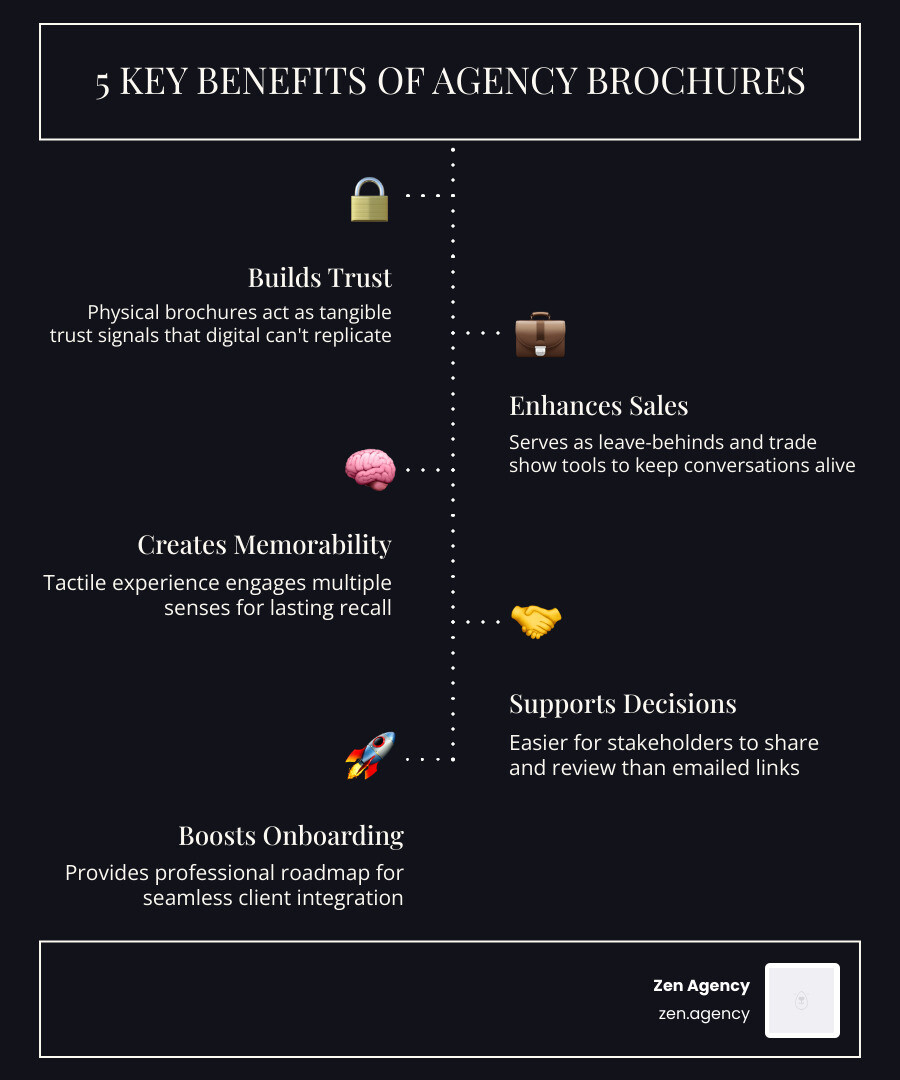
In May 2026, we are more connected than ever, yet the digital fatigue is real. Screens are crowded with pop-ups and notifications. A physical brochure offers a “trust signal” that pixels simply cannot replicate. When we hand a prospect a high-quality piece of marketing, it serves as a tangible reminder of our brand’s authority.
Brochures act as essential sales enablement tools. Whether it’s a “leave-behind” after a high-stakes meeting or a handout at a trade show, a brochure keeps the conversation going when you aren’t in the room. It’s also a powerful part of client onboarding, providing a professional roadmap of what it’s like to work with us.
Why agency brochure design still influences buying decisions
First impressions are formed in milliseconds. A professional agency brochure design communicates that we are established and detail-oriented. Because a brochure is tactile, it engages more senses than a website. It also supports the internal decision-making process; it’s much easier for a marketing manager to hand a physical booklet to their CEO than it is to hope they click a link in a forwarded email.
Print vs digital brochures: when each works best
We don’t have to choose one or the other. In fact, hybrid campaigns are the gold standard in 2026. Print brochures excel at field sales and events, while digital PDF brochures are perfect for quick email follow-ups.
| Feature | Print Brochures | Digital Brochures |
|---|---|---|
| Best Use Case | Trade shows, in-person meetings | Email attachments, website downloads |
| Engagement | Tactile, high memorability | Interactive links, video embeds |
| Tracking | QR codes | Heatmaps, dwell time, click-throughs |
| Updates | Requires reprinting | Instant updates |
10 Essentials Every Agency Brochure Design Needs
A great brochure isn’t just a collection of pretty pictures; it’s a strategic asset. To ensure your agency brochure design succeeds, you must focus on visual hierarchy and scannability. Most readers will skim the headlines first, so they need to be benefit-led and punchy.
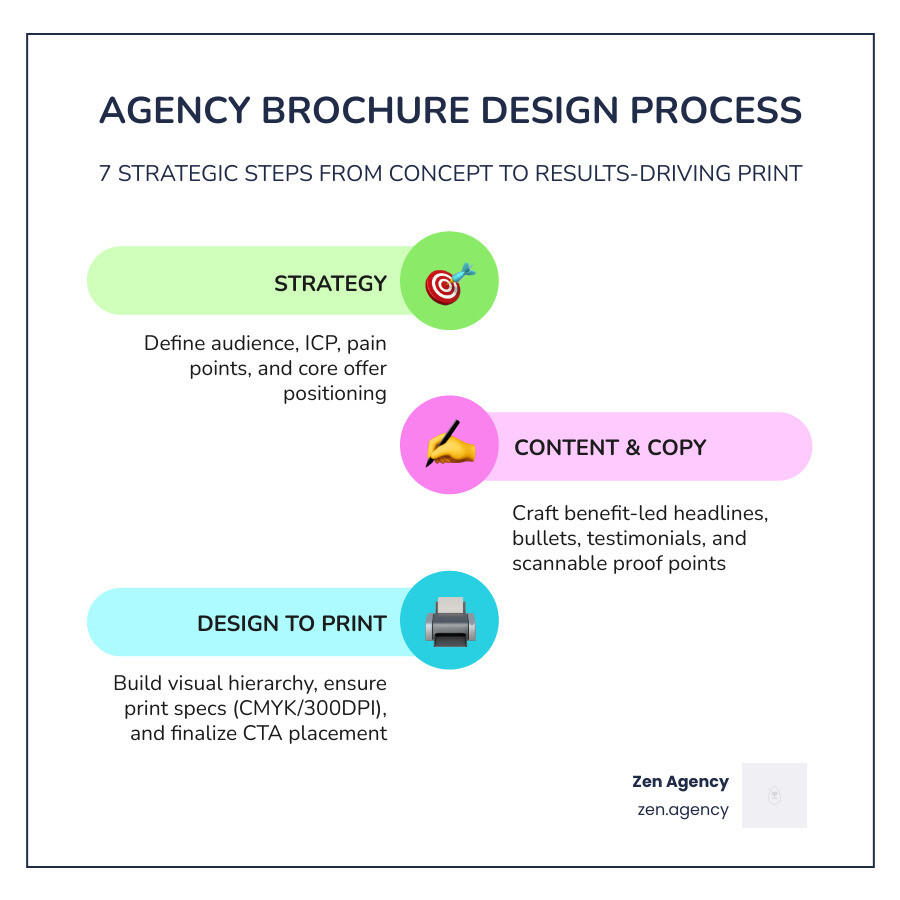
Strategic agency brochure design starts with audience and offer
Before we open any design software, we must define our Ideal Customer Profile (ICP). What are their pain points? What keeps them up at night? Our brochure should address these objections head-on. By structuring the information architecture around the client’s journey rather than just listing our services, we create a more persuasive narrative.
Use psychology, UX, and conversion principles to guide readers
We apply UX principles to print just as we do to web development. Using eye-flow patterns (like the Z-pattern or F-pattern), we guide the reader toward the most important information. Color psychology plays a massive role—for example, blue conveys trust, while orange can spark energy and action. We also utilize Hick’s Law: don’t overwhelm the reader with too many choices. Keep the path to the CTA clear and simple.
Write brochure copy that is concise, persuasive, and easy to scan
Nobody wants to read a wall of text. We use bullet points, short paragraphs, and bold subheaders. Every claim we make should be backed by social proof. According to industry data, popular agency brochure examples often receive hundreds of engagements when they lead with clear, results-oriented messaging. Include stats, brief case studies, and testimonials to build immediate rapport.
Keep branding consistent across brochure and website assets
Your brochure should feel like an extension of your digital presence. This means strict adherence to your Brand Identity Design. From the logo placement to the specific hex codes of your brand colors, consistency is key. If you haven’t yet, check out The Ultimate Guide to Brand Guideline Creation to ensure your team is on the same page. Omnichannel design ensures that when a client moves from your brochure to your site, the transition is seamless.
Choose the Right Format, Fold, and Finish for the Job
The physical format of your brochure says as much about your agency as the words inside. While A4 and US Letter are standard, square brochures are becoming increasingly popular for creative agencies looking for a modern, “boutique” feel.
Best brochure formats for sales pitches, trade shows, and onboarding
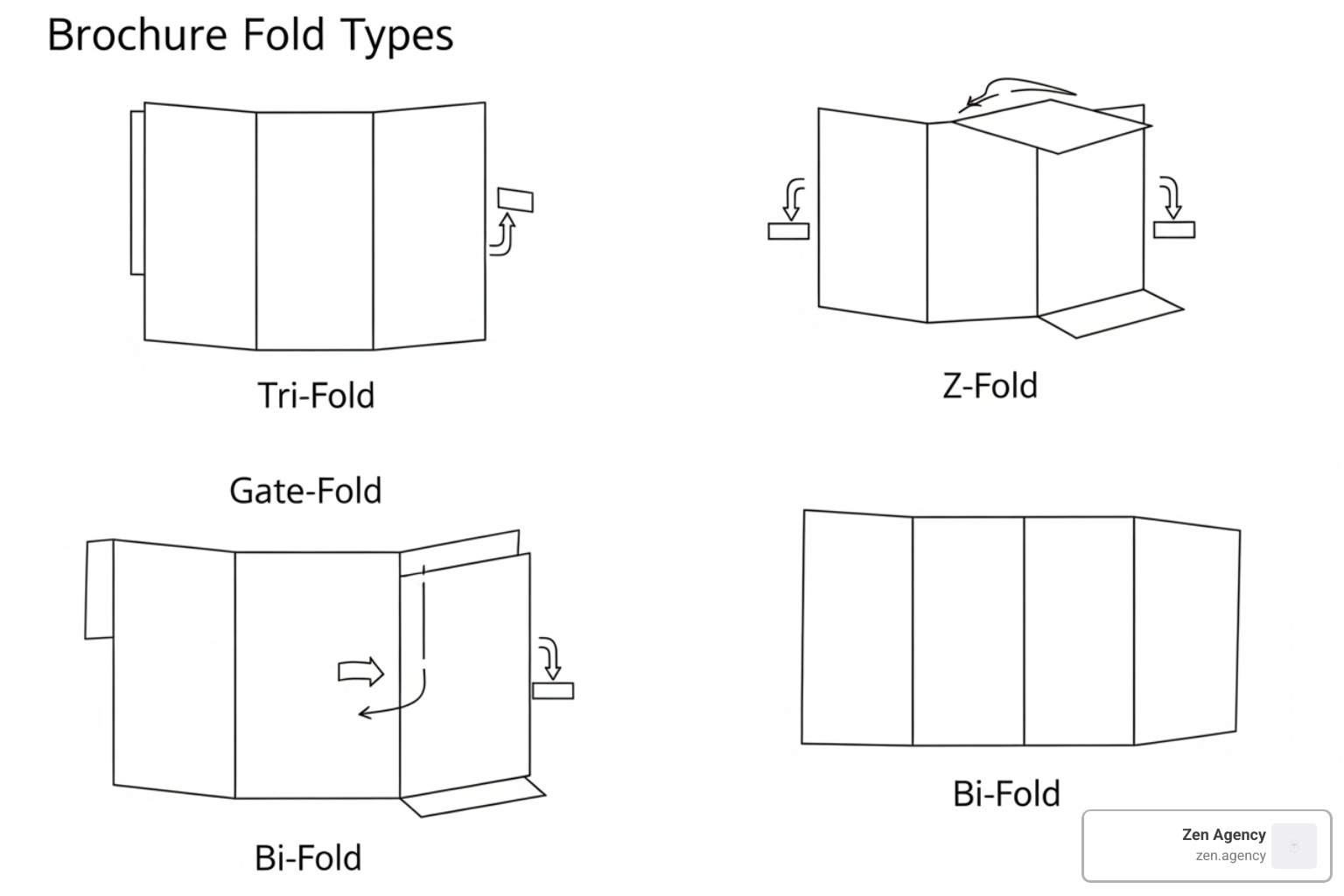
- Tri-fold: The classic. Great for portability and fitting into standard envelopes.
- Bi-fold: Offers a more premium, book-like feel, ideal for high-end sales pitches.
- One-sheets: Perfect for quick “capabilities” overviews at busy trade shows.
- Booklets: Best for onboarding or comprehensive service catalogs where you need 12+ pages. For inspiration, look at Agency brochure template examples.
Industry-specific brochure choices for digital, healthcare, and creative agencies
Different sectors have different expectations. A healthcare recruitment agency needs a design that emphasizes compliance and trust. A digital marketing agency, on the other hand, should showcase innovation through bold layouts and vibrant colors. Creative agencies often benefit from “lookbook” style brochures that let their portfolio pieces do the talking.
Print specs non-designers should never ignore
If you’re designing your own materials using tools like Figma or Canva, you must get the technical specs right.
- CMYK: Always design in CMYK color mode for print (RGB is for screens only).
- 300 DPI: This is the minimum resolution for crisp, professional images.
- Bleed and Margins: Always include a 0.125-inch bleed to ensure your design reaches the very edge of the paper after cutting.
What a Great Brochure Design Agency Actually Delivers
When you hire a specialized agency brochure design partner, you aren’t just paying for someone to move elements around a page. You are paying for a strategic process that includes discovery workshops, content planning, and art direction.
Agency vs in-house vs freelance: what changes in outcomes
While a freelancer might be cheaper, a full-service agency provides a level of accountability and production expertise that is hard to match. Agencies often have a more robust revision workflow and can coordinate directly with print vendors to ensure the final product matches the digital proof.
Services beyond layout and graphics
A comprehensive partner provides:
- Content Strategy: Helping you decide what to say and what to leave out.
- Photography Direction: Ensuring your team photos don’t look like generic stock images.
- Print Vendor Liaison: We handle the technical talk with the printer so you don’t have to.
- Landing Page Tie-ins: Creating a dedicated URL or QR code destination for the brochure.
How subscription-based design support helps growing agencies
Many agencies are moving toward subscription-based models for their design needs. This allows for predictable monthly pricing and ongoing updates. As your services evolve or you launch new campaigns, having a design team on retainer ensures your brochures are never out of date.
Modern agency brochure design trends worth using in 2026
The most effective brochures today bridge the gap between the physical and digital worlds.
Interactive and trackable brochure features that improve engagement
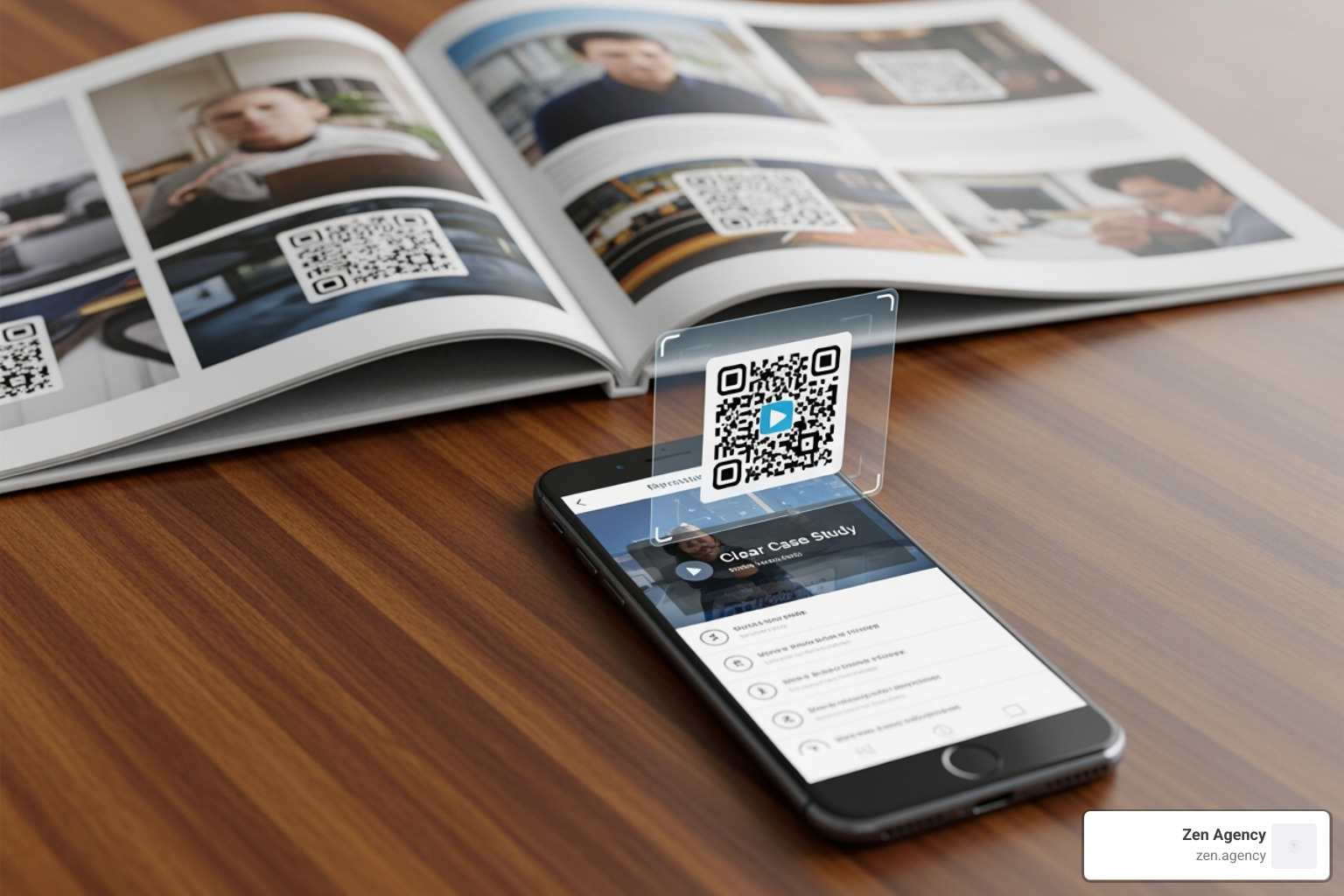
We are seeing a massive rise in “clickable” digital PDFs and the use of QR codes in print. By using UTM links, we can track exactly which brochure led to a website visit. Some agencies are even using AR (Augmented Reality) triggers—where a client can point their phone at a brochure image and see a video case study play on their screen.
Sustainable brochure design without sacrificing premium feel
Sustainability is no longer optional; it’s a brand requirement. In 2026, using recycled paper stocks and soy-based inks is a major selling point. Many of our clients are opting for “right-sized” print runs to reduce waste. You can find excellent Brochure printing options that offer eco-friendly materials without losing that luxury feel.
Where to find visual inspiration without copying competitors
Don’t just look at other agency brochures. Look at high-end editorial magazines, architecture journals, and fashion lookbooks. Websites like Dribbble are fantastic for seeing what top-tier designers are creating in real-time. Use these as a starting point to develop a unique visual language that is all your own.
How to Pick the Right Partner and Measure Brochure ROI
Choosing a partner is about more than just a portfolio. You need to ensure their process aligns with your goals.
Questions to ask before hiring an agency brochure design partner
Before signing a contract, ask:
- Do you have experience in our specific industry?
- Will I own the source files (InDesign/Illustrator) upon completion?
- How do you handle the integration between print and digital versions?
- What is your process for discovery and strategy?
For more help, check out X Tips to Find a Great Graphic Design Agency or our guide on Finding Your Perfect Match.
How to measure brochure performance and ROI
ROI isn’t a mystery if you plan for it. We track:
- QR Scans: How many people engaged with the digital call to action?
- Meetings Booked: Did the brochure lead to a discovery call?
- Sales Feedback: Are the sales reps actually using the tool, and do they find it helpful?
- A/B Testing: Try two different headlines or CTAs in smaller print runs to see which performs better.
Common brochure mistakes that waste budget
Avoid these pitfalls:
- Too much copy: If it looks like a textbook, no one will read it.
- Low-res images: Pixelated photos scream “amateur.”
- No tracking: If you can’t measure it, you can’t improve it.
- Weak CTA: Never assume the reader knows what to do. Tell them.
Frequently Asked Questions about agency brochure design
How long does agency brochure design usually take?
A standard project usually takes 3 to 6 weeks. This includes a week for discovery and strategy, a week for copywriting, and 1-2 weeks for design and revisions. Print production can add another 5-10 business days depending on the complexity of the finish.
What is the best brochure format for a service agency?
For most service agencies, a tri-fold or a 6-page gate fold is the best balance of space and cost. If you have a very complex offering or a large portfolio, a multi-page booklet (8-12 pages) provides a more authoritative feel.
Should agencies create both print and digital brochure versions?
Absolutely. In 2026, an omnichannel approach is mandatory. Your digital PDF should be optimized for mobile viewing (single-page scroll), while your print version is optimized for the physical experience. Both should share the same visual DNA.
Conclusion
Mastering agency brochure design is about more than just aesthetics—it’s about creating a lasting connection with your prospects. Whether you are operating in Scranton, PA, or Billings, MT, a high-quality brochure serves as a silent salesperson that works for you 24/7.
At Zen Agency, we’ve been helping businesses scale since 2008 by combining enterprise-grade design with innovative digital strategies. If you’re ready to stop being ignored and start being remembered, it’s time to invest in a brochure that reflects the true value of your brand.
Ready to elevate your brand? Explore our graphic design services and let’s build something remarkable together.